
A body BMI calculator male helps men estimate their Body Mass Index using height and weight. BMI provides a simple way to check whether a person may have a healthy weight for their height.
Although BMI does not measure body fat directly, it can offer a useful starting point for understanding general weight status. You can use a Body BMI Calculator Male along with other factors, such as waist size, muscle mass, lifestyle and overall health.
Male BMI Calculator
Enter your details to calculate your Body Mass Index.
Your BMI Result
BMI is a screening tool, not a diagnosis. It does not directly measure body fat or distinguish muscle from fat.
What Is a Body BMI Calculator Male?
A body BMI calculator male uses a man’s height and weight to calculate his Body Mass Index.
The basic BMI formula is:
[BMI = \frac{Weight\ in\ kilograms}{Height\ in\ meters^2}]
For example, if a man weighs 80 kilograms and measures 1.80 meters tall:
[BMI = \frac{80}{1.80 \times 1.80}]
[BMI = 24.7]
This result falls within the commonly used healthy BMI range.
A calculator makes this process faster.
Additionally, Body BMI Calculator Male requires you to enter only your height and weight.
How to Calculate BMI for Men
You can calculate BMI using kilograms and meters or pounds and inches.
Using Kilograms and Meters
Use this formula:
[BMI = \frac{Weight\ in\ kilograms}{Height\ in\ meters^2}]
For example:
- Weight: 90 kilograms
- Height: 1.75 meters
[BMI = \frac{90}{1.75 \times 1.75}]
[BMI = 29.4]
The estimated BMI is 29.4.
Using Pounds and Inches
If you use pounds and inches, apply this formula:
[BMI = \frac{Weight\ in\ pounds \times 703}{Height\ in\ inches^2}]
For example:
- Weight: 176 pounds
- Height: 70 inches
[BMI = \frac{176 \times 703}{70 \times 70}]
[BMI = 25.3]
The estimated BMI is 25.3.
Adult BMI Categories for Men
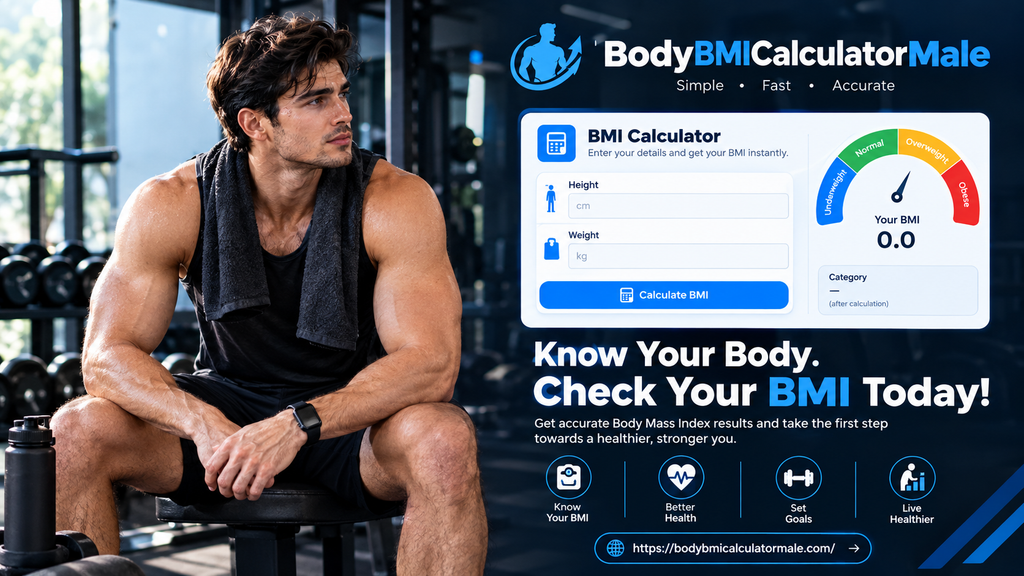
The commonly used BMI categories for adults include:
- Below 18.5: Underweight
- 18.5 to 24.9: Healthy weight
- 25.0 to 29.9: Overweight
- 30.0 or higher: Obesity
These categories provide general guidance. They do not diagnose a medical condition or measure body fat directly.
A healthcare professional can give you a more complete assessment based on your age, body composition, family history and lifestyle.
Why Use a BMI Calculator for Men?
A BMI calculator can help you:
- Estimate your weight category
- Track changes in body weight
- Set realistic fitness goals
- Monitor progress during a weight-management plan
- Understand how your weight compares with your height
- Start a conversation with a healthcare professional
BMI works best as one part of a broader health assessment
BMI Example for Men
Suppose a man weighs 75 kilograms and has a height of 1.75 meters.
Use the BMI formula:
[BMI = \frac{75}{1.75 \times 1.75}]
[BMI = 24.5]
A BMI of 24.5 falls within the commonly used healthy weight category.
However, the result does not show how much of the person’s weight comes from muscle, fat, bone or water.
BMI and Muscle Mass
BMI may not accurately reflect health for men who have a high amount of muscle.
Muscle weighs more than fat. As a result, athletes, bodybuilders and men who perform regular strength training may have a higher BMI even when they have a low body-fat percentage.
For this reason, you should consider other measurements, such as:
- Waist circumference
- Body-fat percentage
- Muscle mass
- Blood pressure
- Cholesterol levels
- Fitness level
- Diet and daily activity
A high BMI does not always mean that a muscular man has excess body fat.
BMI and Age
The standard adult BMI categories generally apply to men aged 20 and older. Children and teenagers need a different method because their bodies continue to grow and develop.
Doctors usually interpret BMI for younger people by comparing it with age- and sex-specific growth charts.
Older adults may also need a more detailed assessment because muscle mass often decreases with age. A healthcare professional can help interpret BMI more accurately in these situations.
BMI vs. Body Fat Percentage
BMI compares weight with height, while body-fat percentage estimates how much of your body consists of fat.
Body-fat percentage can provide additional information, but measurement methods vary in accuracy. Some methods include:
- Skinfold measurements
- Bioelectrical impedance devices
- Body composition scales
- DEXA scans
- Underwater weighing
You should not rely on one measurement alone. Combining BMI with waist measurement, fitness level and general health can provide a clearer picture.
How to Improve Your BMI Naturally
If your BMI falls outside the healthy range, small and consistent lifestyle changes may help.
Eat Balanced Meals
Build meals around vegetables, fruit, whole grains, lean protein and healthy fats. Limit highly processed foods and sugary drinks.
Control Portion Sizes
Large portions can increase calorie intake without providing enough nutritional value. Use smaller plates and eat slowly to recognize when you feel full.
Exercise Regularly
Aim for a combination of aerobic activity and strength training. Walking, cycling, swimming, resistance exercises and sports can support healthy weight management.
Drink More Water
Water supports many body functions and can help replace high-calorie drinks.
Sleep Well
Poor sleep can affect hunger, energy and food choices. Maintain a regular sleep schedule whenever possible.
Set Realistic Goals
Focus on gradual progress instead of extreme changes. Sustainable habits often produce better long-term results.
Common Mistakes When Using a BMI Calculator
Entering the Wrong Units
Make sure you enter pounds with inches or kilograms with meters. Mixing units can produce an incorrect result.
Measuring Height Incorrectly
Stand upright without shoes when measuring your height. A small height difference can affect the final BMI.
Treating BMI as a Diagnosis
BMI does not diagnose obesity, illness or overall health. Use it as a general screening tool.
Ignoring Muscle Mass
Muscular men may receive a high BMI result even when they have a healthy body-fat level.
Focusing Only on One Result
Your BMI can change with weight, height measurements and lifestyle changes. Look at long-term trends instead of focusing on one number.
Tips for Getting an Accurate BMI Result
Follow these steps for a more reliable estimate:
- Measure your weight without heavy clothing.
- Measure your height without shoes.
- Use the correct measurement units.
- Enter your information carefully.
- Repeat the measurement if the result seems unusual.
- Use BMI with other health indicators.
- Speak with a healthcare professional if you have concerns.
Frequently Asked Questions
What is a healthy BMI for men?
A BMI between 18.5 and 24.9 is commonly classified as a healthy range for adults. However, individual health can vary, especially for men with high muscle mass.
Is BMI different for men and women?
The standard BMI formula is generally the same for adult men and women. However, body composition can differ, so healthcare professionals may consider additional factors when assessing health.
Can a muscular man have a high BMI?
Yes. Muscle weighs more than fat, so a muscular man may have a high BMI without having excess body fat.
Is BMI accurate for all men?
BMI provides a general estimate, but it may not accurately reflect health for athletes, highly muscular men, older adults and some ethnic groups.
How often should I check my BMI?
You can check your BMI when your weight or lifestyle changes significantly. Avoid checking too often because daily weight changes can result from water retention and other normal factors.
Can BMI show belly fat?
No. BMI does not show where your body stores fat. Waist circumference can provide additional information about abdominal fat.
Should I lose weight if my BMI is high?
A high BMI may suggest that you should review your weight and lifestyle, but it does not provide a complete diagnosis. Consider speaking with a qualified healthcare professional before making major changes.
Read More:
Proportion Calculator: Solve Ratios Quickly and Easily
Final Thoughts
A body BMI calculator male provides a simple way to compare weight with height. It can help you understand your general weight category and track changes over time.
However, BMI does not measure body fat, muscle mass or overall health on its own. Men with significant muscle mass may receive a high BMI result even when they have a healthy body composition.
For a clearer health assessment, combine your BMI result with waist measurements, body-fat information, fitness level, diet and professional medical advice. Use the calculator as a starting point for better health decisions, not as the only measure of your wellbeing.
- What a Body BMI Calculator Male does: A body BMI calculator male uses height and weight to calculate BMI, offering a quick way to see if weight is generally healthy for height.
- BMI is a starting point, not a direct measure of fat: BMI provides a general weight-status indication and should be considered alongside waist size, muscle mass, lifestyle, and overall health.
- How to calculate BMI (kilograms/meters or pounds/inches): BMI can be calculated using kilograms and meters or pounds and inches, with examples showing typical BMI results such as 24.7 or 25.3 for reference ranges.
- Adult BMI categories for men and their limitations: Common categories are underweight, healthy weight, overweight, and obesity, but these do not diagnose health or account for muscle mass and body composition.
- Tips for accurate BMI results and common mistakes: To improve accuracy, measure weight and height correctly, use proper units, and interpret BMI alongside other health indicators rather than relying on a single number.